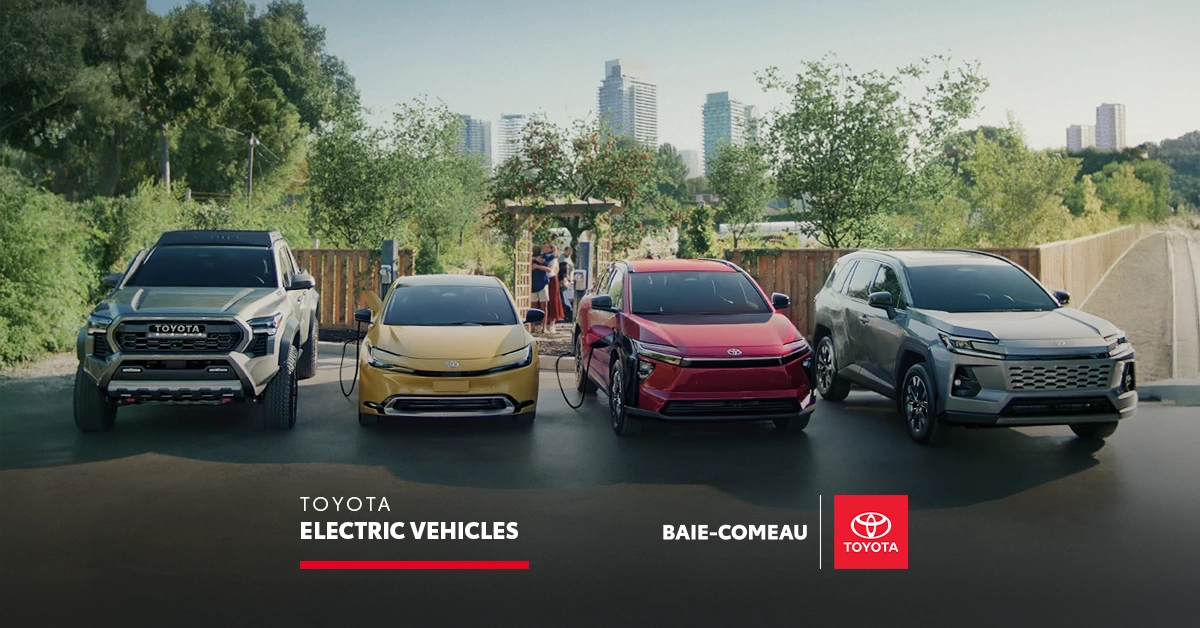
Toyota Electrified Vehicles: understanding the different powertrains and making an informed choice
15 December 2025
Choosing among Toyota Electrified Vehicles can seem complex when faced with several powertrain options: hybrid, plug-in hybrid (PHEV), 100% electric and hydrogen. At Baie-Comeau Toyota, more and more drivers are looking to reduce fuel costs while adopting cleaner technology.
Here is a clear, practical guide to understand what sets each powertrain apart and determine which one truly fits your lifestyle—whether you mostly drive in the city, on the highway, or in a region like the Côte-Nord.
The main families of Toyota electrified powertrains
Before getting into the details, here is a quick overview of the four technologies offered by Toyota:
Hybrid (HEV): operates with a gasoline engine plus an electric motor, with no external charging required.
Plug-in hybrid (PHEV): works like a hybrid but allows external charging to drive several dozen kilometres in electric mode.
Electric (BEV): runs exclusively on electricity thanks to a high-capacity battery.
Hydrogen (FCEV): uses hydrogen converted into electricity to power the motor.
Toyota Hybrid: simplicity, reliability and efficiency
How does it work?
The Toyota hybrid system automatically alternates between the gasoline engine and the electric motor. The battery recharges on its own through regenerative braking and the gasoline engine.
Advantages
No plug-in required: ideal for drivers who want a simple solution.
Reduced fuel consumption, especially in city driving.
Proven reliability (over 25 years of development).
Maintenance costs generally lower than those of conventional vehicles.
Disadvantages
Cannot drive long distances in 100% electric mode.
Less economical if you mainly drive long highway distances.
Plug-in hybrid (PHEV): the balance between gasoline and electric
How does it work?
The battery can be recharged at home or at a public charging station. The vehicle drives in 100% electric mode for distances ranging from 40 to 60 km depending on the model. Beyond that range, it operates like a conventional hybrid.
Advantages
Perfect for short daily commutes.
Significant reduction in fuel costs.
Versatile: no stress if you forget to recharge—gasoline takes over.
Eligible for certain incentives (depending on current policies in Quebec).
Disadvantages
Higher purchase price than a conventional hybrid.
Requires a household outlet or charging station to maximize savings.
Toyota Electric Vehicles (BEV): zero emissions every day
How does it work?
Powered solely by an electric battery, BEVs—such as the bZ4X and future bZ models—require charging via a Level 2 station or fast charging.
Advantages
No gasoline consumption.
Minimal maintenance (no oil changes, no traditional transmission).
Instant acceleration and quiet driving.
Ideal for daily commutes and local travel.
Disadvantages
Reduced range depending on temperature, especially in winter.
Requires access to home charging for the best experience.
Less suitable for frequent long trips without planning.
Hydrogen (FCEV): Toyota’s futuristic vision
Although less common in Canada, hydrogen power—represented by the Toyota Mirai—remains a major technological breakthrough.
Advantages
Ultra-fast refuelling: about 5 minutes.
No emissions other than water vapour.
Range comparable to a gasoline vehicle.
Disadvantages
Infrastructure is almost non-existent in Canada.
Technology is still costly and limited to certain markets.
Toyota Electrified Vehicles: how to choose the ideal powertrain?
To help you decide:
Mainly city driving?
→ The hybrid is the most rational choice: reliable, economical and no charging required.
Driving less than 50 km per day?
→ The PHEV allows you to handle almost all of your daily driving in electric mode.
Want to eliminate gasoline?
→ BEVs deliver clean driving and very low maintenance costs.
Thinking long term and innovation?
→ Hydrogen represents the future, but infrastructure must catch up before it becomes widely accessible.
Need guidance?
The Baie-Comeau Toyota team can guide you based on your budget, driving habits and access to charging. The right choice should fit your reality—not just the technology.
FAQ – Toyota Electrified Vehicles
1. Do hybrid vehicles require a charging station?
No. Hybrids recharge automatically through the regenerative braking system.
2. What’s the difference between a hybrid and a plug-in hybrid?
A PHEV can be plugged in and driven in electric mode for several dozen kilometres, unlike a standard hybrid.
3. Is an electric vehicle efficient in winter?
Yes, but range may decrease. A home charging station maximizes comfort and planning.
4. How often does an electric vehicle need maintenance?
Less often than a gasoline vehicle: no oil changes and fewer moving parts.
5. Is hydrogen a realistic option today?
Not yet for most drivers due to limited infrastructure. But technologically, it’s very promising.
To provide the best experiences, we use technologies like cookies to store and/or access device information. Consenting to these technologies will allow us to process data such as browsing behavior or unique IDs on this site. Not consenting or withdrawing consent, may adversely affect certain features and functions.
Functional
Always active
The technical storage or access is strictly necessary for the legitimate purpose of enabling the use of a specific service explicitly requested by the subscriber or user, or for the sole purpose of carrying out the transmission of a communication over an electronic communications network.
Preferences
The technical storage or access is necessary for the legitimate purpose of storing preferences that are not requested by the subscriber or user.
Statistics
The technical storage or access that is used exclusively for statistical purposes.The technical storage or access that is used exclusively for anonymous statistical purposes. Without a subpoena, voluntary compliance on the part of your Internet Service Provider, or additional records from a third party, information stored or retrieved for this purpose alone cannot usually be used to identify you.
Marketing
The technical storage or access is required to create user profiles to send advertising, or to track the user on a website or across several websites for similar marketing purposes.